
Zooming hawk Chocolate soars through sky, catching eye of community
Imagine you’re around the football field or in the Community Partners room, and you look up and there is a small bird flying through the sky. Out of nowhere, you see another bird–a white and brown red-tailed hawk– snatch it up and fly into the sky. You don’t have to imagine anymore because you might spot one this year.
This is a real story experienced by mentor Amy Alvarado who mentioned seeing one while working in the Community Partners area.
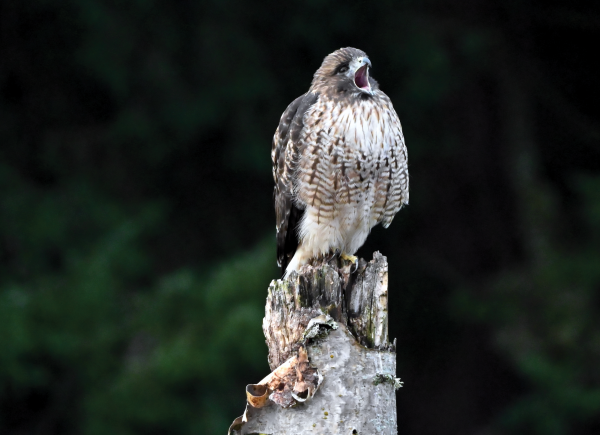
Kee-Aah! Turns out, the bird mentioned is Chocolate, the red-tailed hawk that has been seen around McDaniel. Chocolate was first spotted by Melanie Loveland and Ginger Neil. They live in the McDaniel Neighborhood. Both Loveland and Neil have been taking pictures of Chocolate, and agreed to an interview where they were able to collectively answer the following questions.
Q: Who is Chocolate?
A: Chocolate is a red-tailed Hawk, who is 13-14 months old.
Q: When did you guys start seeing Chocolate?
A: The afternoon of Dec. 24, 2024, Christmas Eve Day. Chocolate was our Christmas present!
Q: How did they get their name, and what kind of hawk is it?
A: We first spotted this young red-tailed hawk, who was a juvenile at the time, on the back nine of the golf course. He was mostly white and dark brown feathers. After seeing him several times, we named him ‘Chocolate’ as he looked like a chocolate sundae.
Q: Why do you think they’re around the McDaniel area?
A: Red-tailed hawks have a two-square mile circumference of their range for hunting. With Chocolate being comfortable in the back nine of the golf course for his habitat, he eventually expanded his range of hunting. McDaniel’s football field is a large open area, which is ideal for red-tailed hawks to hunt. Given that their main diet is mice and other rodents, he has found an abundance of food. This is a very positive situation for him and also illustrates why no rat poison should ever be used. It would cause his death.
Q: What would you like the community to know about Chocolate?
A: We photograph and document not only Chocolate, but our other two tagged red-tailed hawks. Their names are E/J (a female) and #21, who is the male and her now lifelong mate. Chocolate does follow them around, and they are now all in the same two-mile range for habitat and food.
Our goal is to raise awareness with the community to not only appreciate our wildlife but to ensure their habitat is not disturbed by urban development, loss of tree canopy, and their food source (the rodents) poisoning them. Very important right now is that we know that Chocolate experienced a window strike at the school. Ultimately, all the windows (especially on the south side of the high school) should all have bird-strike window film, which is a UV film so that the birds do not hit the window. The reflection from the trees onto the windows gives the birds the illusion they can fly through. Window strikes kill over a billion birds a year. That number is correct, a billion.
Q: Do you have any stories you could tell me about Chocolate?
A: We’ve learned through observation that Chocolate has an extraordinarily tolerant behavior of humans (all the students/teachers) at the school even while baseball or soccer games are being played. Most red-tailed
hawks and other wildlife would not tolerate this situation. He is a fierce hunter. He may be a young adult, but there is a large percentage of red-tailed hawks that do not live past five years old. Life is very hard for them.
Q: What are some fun facts about Chocolate?
A: He started getting his first red tail feathers this year. In the photos, can see the secondary layer of red feathers coming, yet he won’t have them fully grown out until next year. They, in general, have a total of 12 red feathers. They do molt once a year. The molting is timed very slowly as they drop off one feather and then a new one is grown.
Q: How long have y’all been bird watching?
A: Six years or longer.
Q: What can you tell me about Chocolate’s species?
A: Red-tailed hawks are known for their impressive eyesight, which can be eight times better than a human’s, and for mating for life. They are also famous for being the “eagle” scream in many movies and TV shows, and for their adaptability, as they can be found in both rural and suburban areas, and even urban environments like New York City.
Chocolate will continue to grow and be spotted around McDaniel. We can make sure of that by creating a safe environment for wildlife to ensure you continue to see Chocolate, and other red-tailed hawks around the school, and maybe even sitting outside your classroom.